


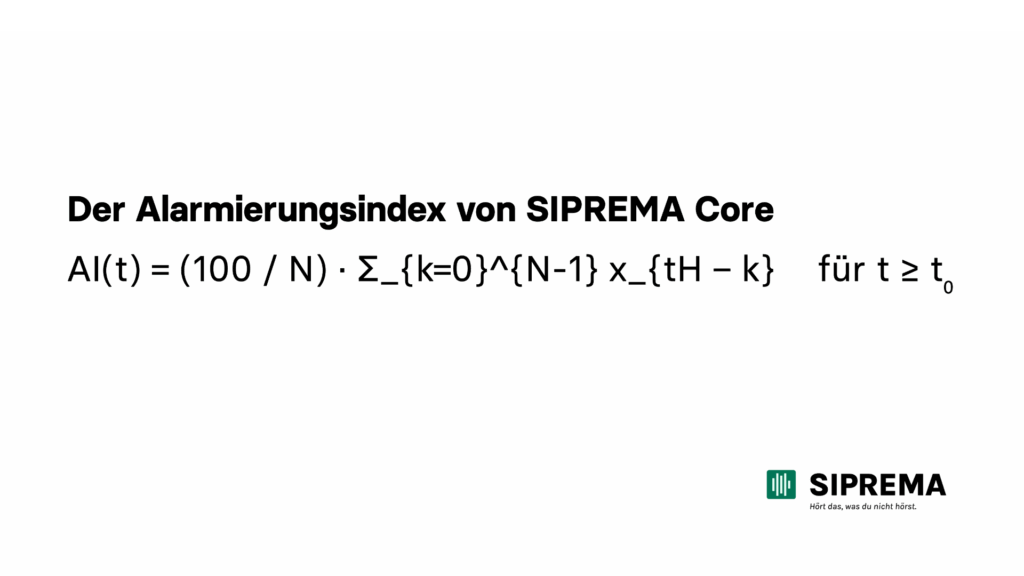

In traditional condition monitoring, individual abnormalities are often interpreted in detail: What kind of sound is this? What is the cause? Is it relevant or harmless? This approach is technically sound, but it requires each deviation to be evaluated individually.
The alarm index of SIPREMA Core follows a different principle. It does not focus on individual anomalies, but on the accumulation of anomalies over time. In practice, it becomes clear that when the condition of a machine deteriorates, overall acoustic deviations from the normal state increase—even if individual sounds are still unspecific on their own.
This development is captured mathematically by the alarm index. The underlying formula aggregates anomalies over a defined time window and condenses them into a normalized value between 0 and 100. Short-term random disturbances lose significance, while systematic changes become visible. What matters is not the single event, but the pattern over time.
After a short learning phase—typically seven days—SIPREMA Core understands the normal acoustic behavior of the machine. Based on this, the system automatically proposes a threshold for alarming. When this threshold is exceeded, it provides a reliable indication that the machine condition is changing. The threshold can be adjusted if required, without any further configuration.
The strength of this approach lies in its deliberate reduction. Since no qualitative evaluation of individual anomalies is required, there is no need for manual feedback or ongoing training. Alarm triggering is based solely on the statistical development of anomaly occurrence. This makes acoustic condition monitoring truly plug-and-play—and allows relevant changes to be detected at an early stage.