

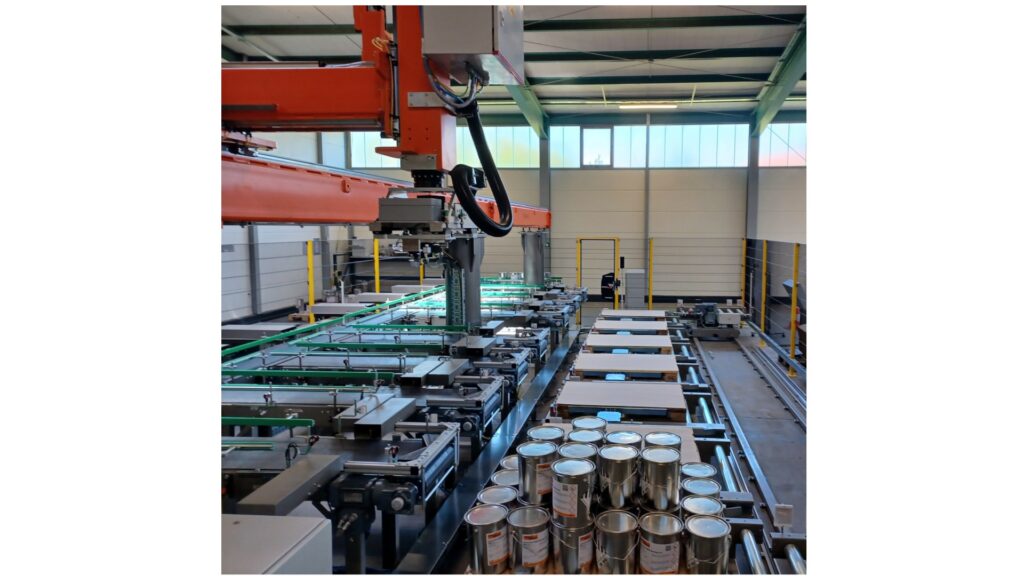

In the filling area of the EX zone, the tinplate containers are filled at several filling stations and initially pushed along short, non-driven roller conveyors to a link-chain conveyor. This transports the containers out of the filling area and transfers them to the conveyor system outside the EX zone. The containers then first pass through a weighing and camera station. The scale performs a 100% weight check of all containers in accordance with the Prepackaged Goods Ordinance; the cameras recognize the barcode and the position of the snap closure. All information is passed on to the control system so that the products are conveyed to the assigned, single-variety palletizing stations. After the weighing and camera station, the tinplate containers are fed to the robot. For efficient and fast, single-variety palletizing, the system has seven palletizing stations including the corresponding feeders, allowing seven different items to be palletized simultaneously. To achieve the required reach, de Man relied on a linear robot from KUKA (type KR 80L) with an impressive length of approximately twelve meters. The link-chain conveyor transports the containers to the transfer points on the infeed belts for the palletizing stations. A discharger pushes them onto the infeed belt for the respective palletizing station, where they are conveyed to a stop. The robot then removes the containers with its gripper and places them on the pallet at the corresponding palletizing station according to the previously defined palletizing pattern. To grip, the linear robot positions its gripper with the pressure plate on the lid, then the gripper jaws grip the containers by the side of the casing. The cycle time is eight seconds. Smooth pallet transport is ensured by two transverse carriages.

