

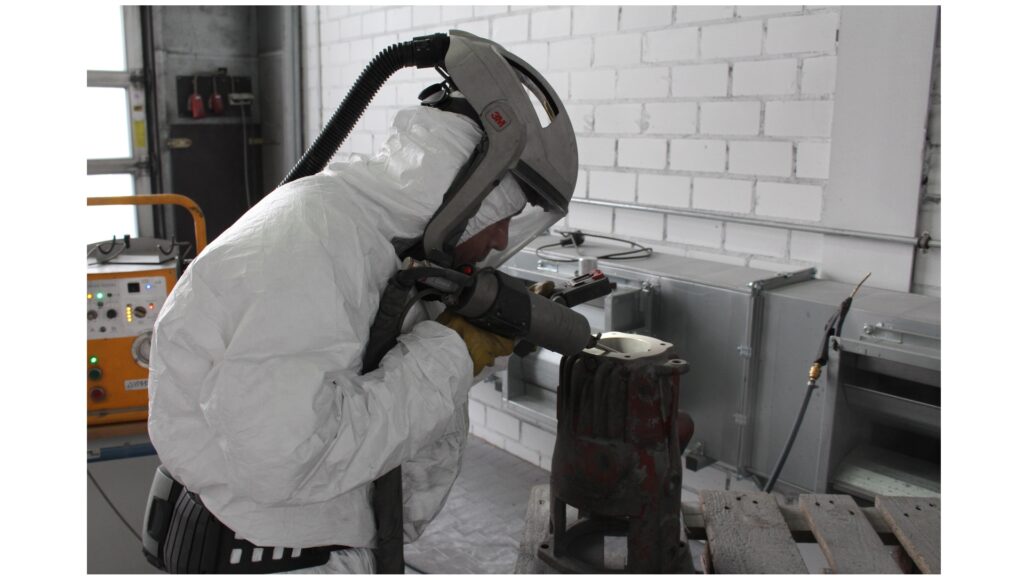
Does your engine show signs of cavitation damage, rust, or scoring? Are the damaged components no longer available on the market, or would replacement be too costly? Bücker + Essing offers a fast, effective, and economical repair solution with its cold gas coating technology, salvaging long-serving components such as engine blocks, cylinder heads, liner seats, intake manifolds, charge air pipes, and much more. A powdered coating material is applied to the damaged area with millimeter precision and at supersonic speed via a Laval nozzle. The kinetic energy of the high speed alone bonds the powder to the substrate surface, forming a new, ultra-strong metallic layer. In a second step, the excess material is removed, and the surface is precisely machined to the manufacturer's specifications. The result: a component that is restored to its original shape and condition. Whether for bus engines, classic cars, marine applications, or combined heat and power (CHP) units, the applications for cold gas coating technology are diverse, and in principle, all components made of steel, aluminum, and cast iron can be treated with it. The process can also be used for surface finishing, as the resulting new layer is highly corrosion-resistant. The advantages of cold gas technology: – Cold gas spraying is suitable for all common metals such as steel, aluminum, and cast iron. – It can be used for components such as engine blocks, cylinder heads, intake manifolds, replacement manifolds, charge air pipes, cylinder liner seats, and cylinder liner bearing surfaces. – Because the coating material adheres to the workpiece without melting, the technology eliminates all the adverse effects of heat exposure, such as stresses, strains, or component distortion that occur during thermal processes. – Due to the low temperatures, the workpiece can be processed immediately. – The process is also suitable for surface finishing.

